

White Spirit Distillation Range
White Spirit is a petroleum-derived solvent widely used in paints, coatings, cleaning products, and industrial formulations. Its performance depends on several physical and chemical properties. One important characteristic is its distillation range.
The distillation range describes the temperatures at which different components of White Spirit evaporate. This property influences evaporation behavior, drying performance, solvent retention, and formulation stability.
Understanding this range helps manufacturers select suitable grades for specific industrial applications. It also provides valuable information when evaluating solvent quality before purchasing.
What Is the Distillation Range of White Spirit?
The distillation range refers to the temperature interval between the initial boiling point and the final boiling point of a solvent. It indicates how different hydrocarbon components behave during heating.
White Spirit contains a mixture of hydrocarbons rather than a single chemical compound. Therefore, its components do not evaporate at one specific temperature. Instead, they gradually vaporize across a defined temperature range.
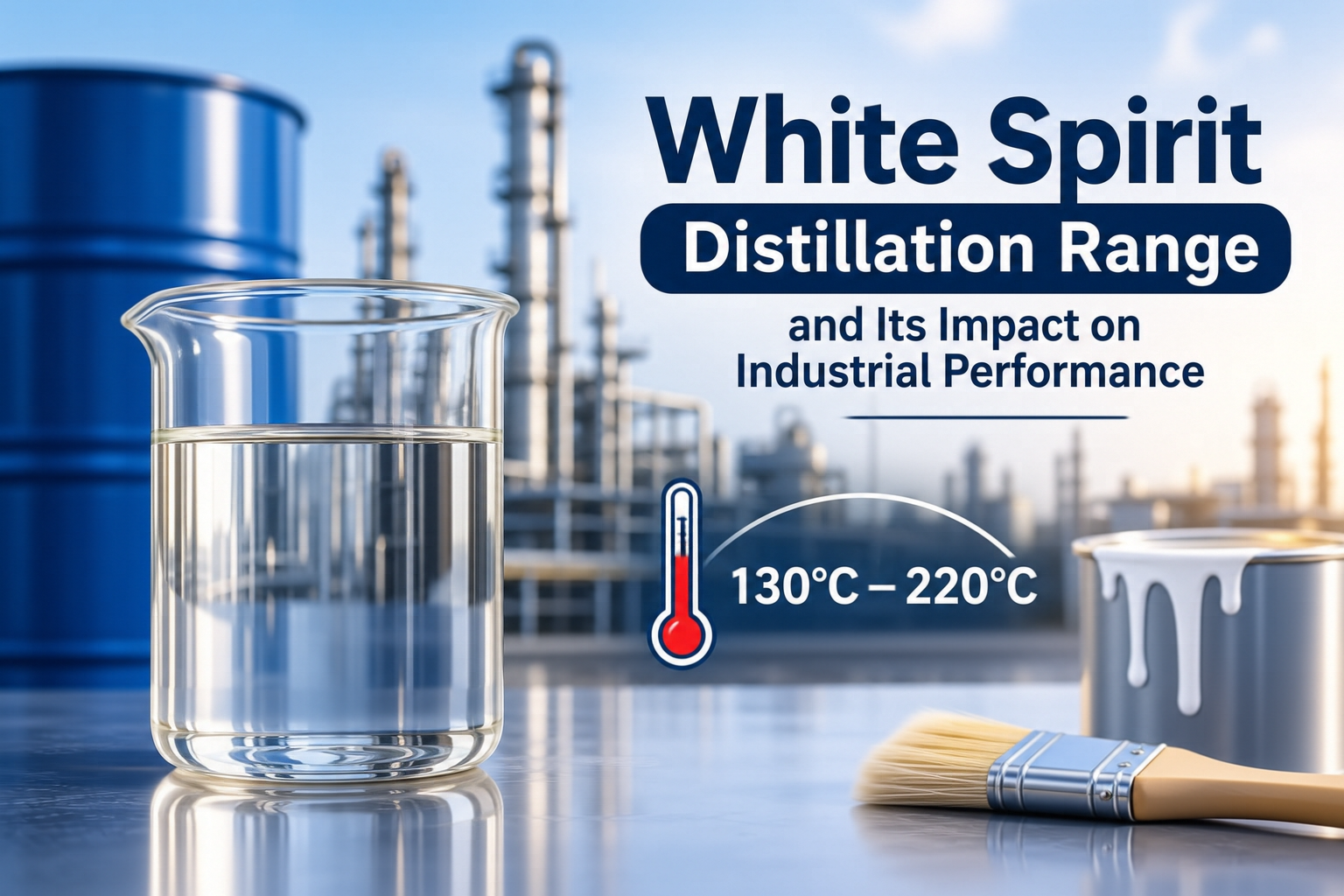
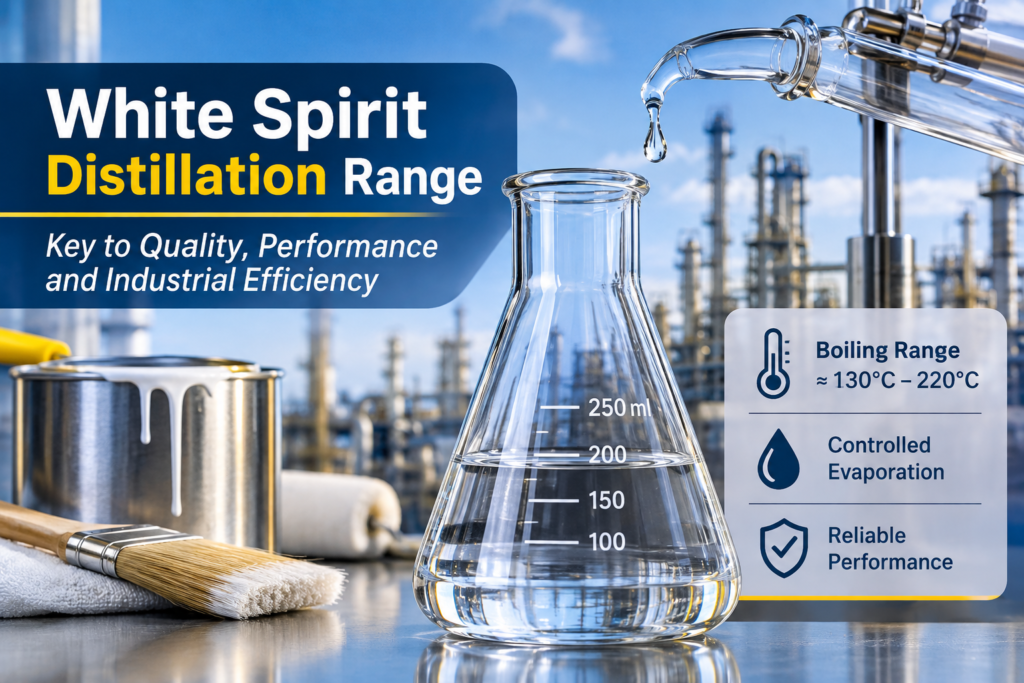
Depending on the grade and manufacturing specifications, White Spirit commonly has a boiling range of approximately 130°C to 220°C. However, commercial products may have different specifications.
This variation results from differences in refining processes, hydrocarbon composition, and intended industrial applications.
Key Factors Affecting the Distillation Range
Several factors determine the distillation characteristics of White Spirit. These factors influence both product specifications and its suitability for different industrial processes.
Hydrocarbon Composition
The molecular structure and carbon number distribution of hydrocarbons directly affect boiling temperatures. Generally, heavier hydrocarbon molecules have higher boiling points.
Consequently, White Spirit containing a larger proportion of heavier components tends to exhibit a higher distillation range. Lighter components, meanwhile, evaporate at lower temperatures.
Refining and Production Processes
Refining methods play an important role in determining the final composition of White Spirit. Distillation, fractionation, and additional refining stages help control the distribution of hydrocarbon components.
Manufacturers can adjust these processes to produce solvents with specific boiling characteristics. As a result, different commercial grades offer different evaporation profiles.
Product Grade and Specifications
Industrial White Spirit is available in several grades with different physical and chemical properties. These differences affect its distillation range and suitability for particular formulations.
For example, manufacturers may require a solvent with a relatively narrow boiling range. This provides more predictable evaporation behavior during production and application.
How Does the Distillation Range Affect Evaporation?
The distillation range has a direct relationship with the evaporation behavior of White Spirit. However, these properties are not exactly identical.
A solvent with a lower initial boiling point generally contains more volatile components. These components evaporate more readily under comparable conditions.
Conversely, a grade with a higher boiling range generally evaporates more slowly. Its heavier components require higher temperatures to vaporize.
A wider distillation range may also indicate a broader distribution of hydrocarbon components. Therefore, evaporation can continue over a longer period.
These characteristics are particularly important in industrial coatings. Manufacturers must balance solvent evaporation with application requirements and film formation.
The Importance of Distillation Range in Paint and Coating Formulations
White Spirit plays an important role in many solvent-based paint and coating formulations. Its evaporation characteristics influence the behavior of coatings during application and drying.
A suitable distillation range helps manufacturers control several important formulation characteristics.
Drying Time Control
The evaporation profile affects how quickly a coating loses its solvent content. Faster evaporation may shorten drying time under suitable conditions.
However, excessively rapid evaporation can create application difficulties. Therefore, selecting an appropriate grade is essential.
Surface Appearance
Solvent evaporation influences the formation of the final coating film. An unsuitable evaporation profile may contribute to surface defects or uneven film formation.
A properly selected White Spirit grade helps maintain consistent application behavior.
Formulation Consistency
Industrial paint manufacturers require predictable solvent performance. Consistent distillation characteristics support better control over formulation behavior.
Furthermore, selecting a grade with suitable specifications can reduce unwanted variations between production batches.
Distillation Range and Industrial Cleaning Performance
White Spirit is also used in industrial cleaning and degreasing operations. Its ability to dissolve oils, grease, and certain organic residues makes it useful in different manufacturing environments.
The distillation range influences how long the solvent remains on a treated surface. This characteristic can affect cleaning time and subsequent solvent removal.
Grades with higher boiling characteristics may remain on surfaces longer under comparable conditions. This can be useful when longer contact time is required.
However, the appropriate grade depends on the type of contamination and cleaning process. Manufacturers should also consider material compatibility and ventilation requirements.
How Is the Distillation Range Measured?
Laboratories commonly evaluate the distillation characteristics of petroleum-based solvents using standardized distillation procedures.
ASTM D86 is one widely used method for determining the boiling range of petroleum products. During testing, a measured sample is heated under controlled conditions.
The temperature is recorded as different portions of the sample evaporate and condense.
Important measurements include:
- Initial Boiling Point (IBP): The temperature at which the first portion of the sample distills.
- Intermediate Recovery Temperatures: Temperatures recorded at specified recovery percentages.
- Final Boiling Point (FBP): The temperature associated with the end of the distillation process.
- Recovery and Residue: The amounts of collected distillate and remaining material.
These results help manufacturers evaluate product consistency and compare different commercial grades.
What Should Buyers Consider When Selecting White Spirit?
Understanding distillation characteristics can help industrial buyers make more informed purchasing decisions. However, the boiling range should not be evaluated independently.
Several additional parameters deserve attention before placing a bulk order.
- Initial and Final Boiling Points: Check whether the specified temperature range matches the intended process.
- Evaporation Requirements: Select a grade with suitable volatility for the application.
- Hydrocarbon Composition: Consider the relationship between composition and solvent performance.
- Aromatic Content: Verify aromatic levels when formulation requirements impose specific limits.
- Product Consistency: Compare technical specifications across different production batches.
- Quality Documentation: Request a technical data sheet and certificate of analysis when available.
Additionally, buyers should consider packaging, transportation conditions, storage requirements, and supplier reliability.
Storage Conditions and Distillation Stability
Proper storage helps maintain the quality and consistency of White Spirit. Although its distillation characteristics are primarily determined during production, contamination can affect product quality.
Exposure to unsuitable storage conditions may introduce impurities or cause unwanted changes in product composition.
For this reason, industrial users should follow appropriate storage practices:
- Store the solvent in tightly sealed, compatible containers.
- Keep storage areas away from direct sunlight and excessive heat.
- Maintain suitable ventilation in storage facilities.
- Avoid contact with incompatible materials.
- Follow applicable fire safety and handling regulations.
These measures help preserve product quality and support safe industrial operations.
Conclusion
The distillation range is an important parameter for evaluating White Spirit quality and industrial performance. It influences evaporation behavior, drying characteristics, cleaning efficiency, and formulation consistency.
Understanding the relationship between boiling temperatures and hydrocarbon composition helps manufacturers select suitable solvent grades. Furthermore, evaluating technical specifications reduces purchasing risks and improves production control.
For businesses requiring reliable industrial solvents, choosing an experienced supplier is equally important. Sipan Holding provides industrial chemical supply solutions and supports buyers in selecting suitable products for their requirements.
Contact Sipan Holding to discuss White Spirit specifications, bulk purchasing requirements, and industrial supply options.

