



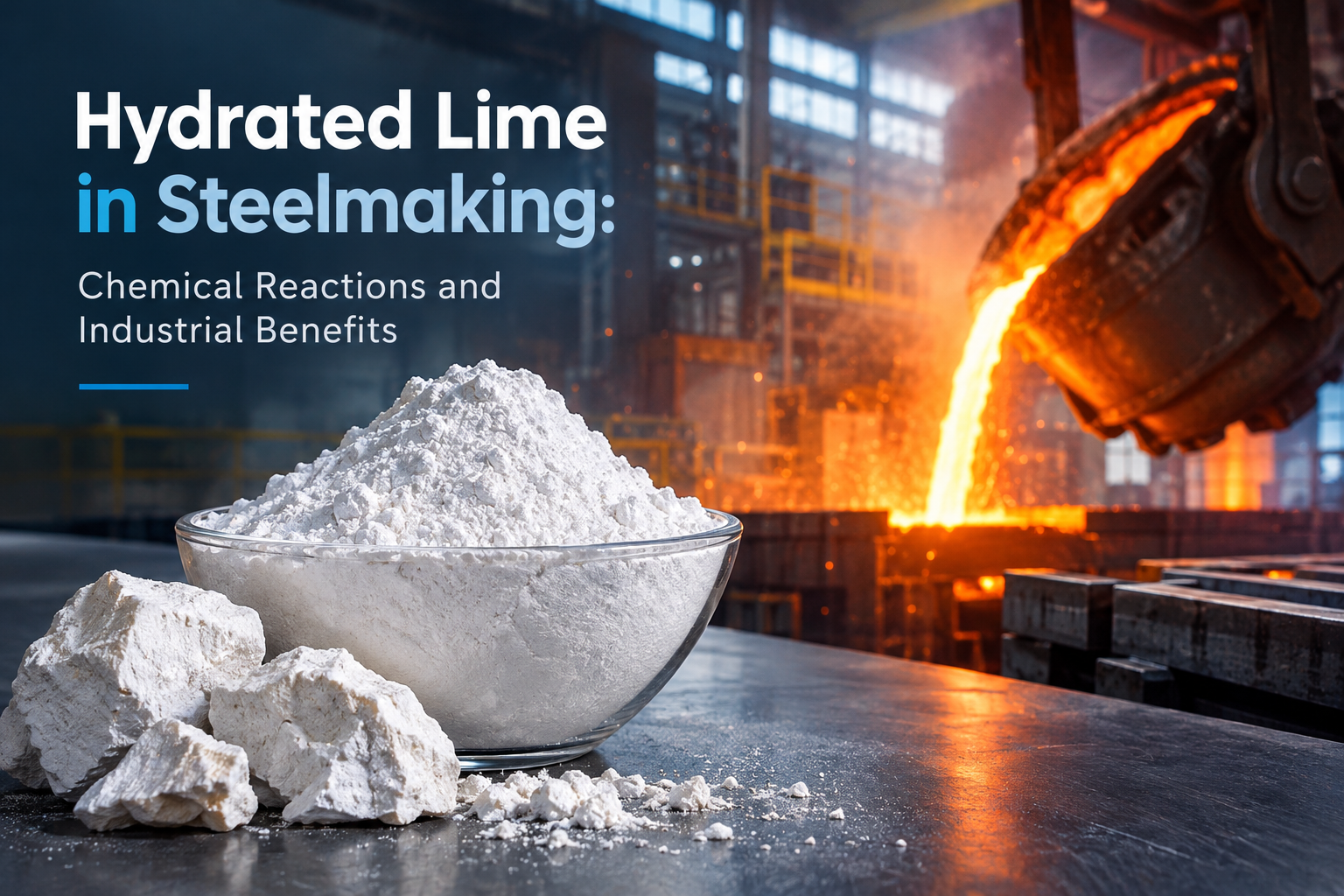
Hydrated Lime in Steelmaking: Chemical Reactions and Industrial Benefits
Hydrated lime is an important industrial material in steel production, where it supports impurity removal, slag formation, and process efficiency. Its chemical properties make it valuable in several stages of steelmaking, particularly when controlling phosphorus, sulfur, and other unwanted components. Understanding how hydrated lime behaves during these processes helps manufacturers select suitable materials and improve production performance.
What Is Hydrated Lime in Steelmaking?
Hydrated lime, chemically known as calcium hydroxide Ca(OH)2 is produced by reacting quicklime with water. It is a fine, alkaline powder with properties that make it useful in metallurgical applications.
In steelmaking, lime-based materials help control the chemical composition of slag and support the removal of impurities from molten metal. Hydrated lime can also serve as a source of calcium compounds in specific industrial processes. However, quicklime is more commonly used in high-temperature steelmaking because it contains less moisture and reacts differently under furnace conditions.
The Chemical Properties of Hydrated Lime
The main characteristic of hydrated lime is its alkalinity. When it reacts with acidic components, it can form calcium-containing compounds that contribute to impurity control.
Its chemical behavior depends on factors such as purity, particle size, moisture content, and reaction temperature. Fine particles generally provide a larger surface area, which can improve reaction rates under suitable conditions.
Furthermore, the material’s calcium content influences its effectiveness in industrial formulations. Manufacturers therefore evaluate chemical composition and physical properties before selecting lime for metallurgical applications.
How Lime Supports Slag Formation
Slag is a molten or semi-molten mixture that collects unwanted components during steel production. Its composition affects impurity removal, metal quality, and furnace performance.
Calcium oxide, which is supplied primarily through quicklime, reacts with acidic oxides to form calcium-containing slag compounds. These reactions help establish the basicity required for particular steelmaking operations.
Hydrated lime can contribute calcium to certain processes, but its moisture content must be considered carefully. In conventional high-temperature furnaces, quicklime is generally preferred because water release can increase energy requirements and create operational concerns.
The Role of Lime in Phosphorus Removal
Phosphorus is an unwanted element in many steel grades because excessive concentrations can reduce toughness and affect mechanical performance. Steelmakers therefore control phosphorus levels through carefully managed refining processes.
Basic slag containing calcium oxide supports phosphorus oxidation and its transfer from molten steel into the slag. This process depends on oxygen availability, temperature, slag composition, and the chemical conditions inside the furnace.
Although hydrated lime contains calcium in hydroxide form, its suitability depends on the specific process. In most conventional refining applications, quicklime provides the principal calcium oxide source.
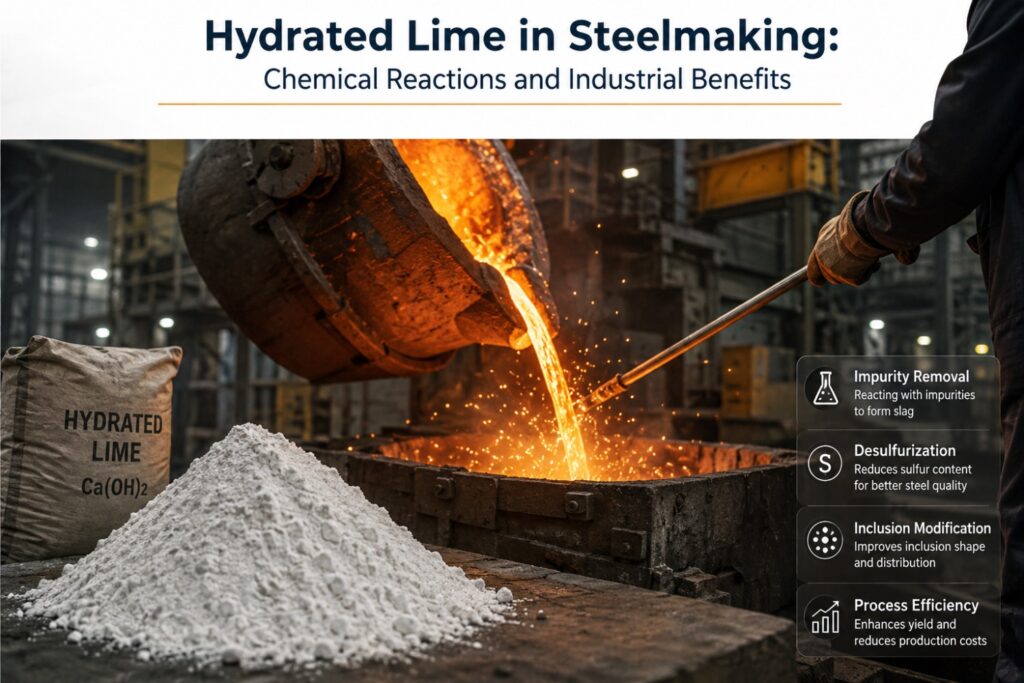
Lime and Sulfur Control in Steel Production
Sulfur can negatively affect steel quality, particularly when manufacturers require specific mechanical properties. Its removal typically takes place under controlled refining conditions.
Calcium-containing materials help create slag compositions that support sulfur transfer from the metal into the slag. Effective desulfurization depends on factors such as slag basicity, oxygen potential, temperature, and contact between the metal and slag.
Hydrated lime may be useful in selected treatment applications, but it is not automatically interchangeable with quicklime. The appropriate material depends on the process design and the required chemical performance.
The Influence of Particle Size on Reactivity
Particle size affects how quickly lime-based materials interact with other substances. Smaller particles generally provide more exposed surface area, potentially improving dissolution and reaction rates.
However, extremely fine powders can create handling challenges, including dust generation, material loss, and uneven feeding. Particle size must therefore balance chemical performance with practical operating requirements.
Consistent particle distribution also helps manufacturers maintain predictable material dosing. For this reason, suppliers and steel producers often assess particle-size specifications alongside chemical purity.
Temperature and Moisture Considerations
Temperature strongly influences the behavior of lime-based materials in metallurgical operations. Hydrated lime releases water when heated sufficiently, eventually converting into calcium oxide.
This reaction can be represented as:
Ca(OH)2 → CaO + H2O
The released water can affect heat balance and process conditions. Consequently, conventional steelmaking operations generally favor quicklime when a direct source of calcium oxide is required.
Moisture control also matters during storage and transportation. Hydrated lime should be kept in dry, well-sealed conditions to prevent contamination, caking, and deterioration of handling properties.
How Lime Quality Affects Steelmaking Efficiency
The quality of lime-based materials can influence chemical consistency, consumption rates, and process stability. Variations in calcium content or impurities may change how the material performs during treatment.
Steel producers should evaluate calcium hydroxide content, available calcium oxide after processing, particle size, moisture, and relevant impurity levels. The most important specifications depend on whether the material is used directly or converted into another calcium-based product.
Reliable quality control helps reduce unexpected process variations. It also supports more consistent production outcomes and more effective material planning.
Selecting the Right Lime-Based Material for Industrial Use
Selecting an appropriate lime product requires a clear understanding of the intended application. A material suitable for wastewater treatment or gas cleaning may not meet the requirements of direct steelmaking operations.
Before purchasing, manufacturers should review the technical data sheet, chemical composition, particle-size distribution, moisture specifications, packaging, and consistency between batches. They should also confirm whether the process requires hydrated lime or quicklime.
Working with a reliable industrial supplier helps ensure that the selected material matches the intended application. Clear specifications and dependable supply arrangements can also support production planning and reduce procurement risks.
Conclusion
Hydrated lime offers valuable chemical properties for several industrial applications, while lime-based materials play a major role in steelmaking and impurity control. Nevertheless, hydrated lime and quicklime serve different functions, particularly under high-temperature conditions.
Understanding their chemical behavior, moisture characteristics, and process requirements helps manufacturers make better material-selection decisions. For industrial lime supply, product specifications and application suitability should always guide the purchasing process.
For industrial lime inquiries and purchasing, contact Sipan Holding to discuss your requirements and suitable supply options.

