



Nitric Acid Impurities
Nitric acid is an important industrial chemical used in various manufacturing processes. Its quality depends not only on concentration but also on the presence of impurities. Even small amounts of unwanted substances can influence its chemical behavior, storage stability, and suitability for specific applications.
Understanding nitric acid impurities is essential for manufacturers, distributors, and industrial buyers. Proper quality assessment helps reduce production risks and ensures more consistent results. Therefore, identifying impurity sources and evaluating their effects are important steps in selecting industrial-grade nitric acid.
What Are the Main Impurities in Nitric Acid?
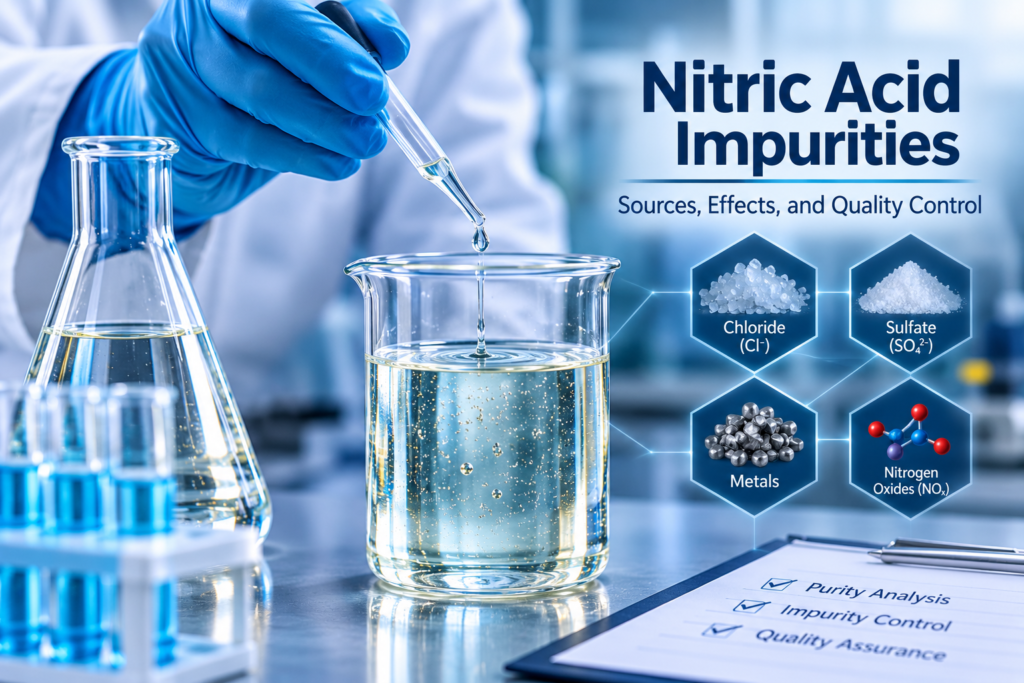
Industrial nitric acid may contain different impurities depending on its production process, raw materials, and storage conditions. Some of the most important impurities include chloride ions, sulfate ions, dissolved metals, and nitrogen oxides.
Their presence and concentration depend on manufacturing technology and product specifications. However, not every impurity has the same effect on product performance.
For this reason, industrial buyers should evaluate the chemical composition rather than relying exclusively on the stated acid concentration.
Chloride Contamination
Chloride ions are among the impurities that require careful attention in nitric acid quality control. Their presence can affect the behavior of the acid in certain industrial environments.
In particular, chloride contamination may increase localized corrosion risks when combined with unsuitable materials and operating conditions. This issue becomes especially important in processes involving metal surfaces and sensitive equipment.
Therefore, chloride concentration should be evaluated when the intended application requires strict chemical purity.
Sulfate Impurities and Their Effects
Sulfate ions may enter nitric acid through raw materials, manufacturing processes, or contamination during handling. Their presence can influence product specifications and process compatibility.
In applications requiring controlled chemical composition, excessive sulfate levels may create unwanted variations. Consequently, monitoring sulfate content is an important part of quality assurance.
Industrial users should compare laboratory results with the technical requirements of their production processes before purchasing.
Dissolved Metals in Nitric Acid
Metallic impurities can originate from production equipment, storage containers, transfer systems, or contaminated raw materials. Iron, copper, and other metal ions may be present depending on manufacturing and handling conditions.
These substances can influence the suitability of nitric acid for sensitive applications. Furthermore, their effects may vary according to concentration and the chemical environment.
For this reason, trace metal analysis is particularly important when purchasing nitric acid for applications with strict purity requirements.
Nitrogen Oxides and Product Appearance
Nitrogen oxides are closely associated with nitric acid production and chemical equilibrium. Their presence can influence the appearance and properties of the final product.
For example, dissolved nitrogen dioxide may contribute to yellow or brown coloration. However, product color alone cannot determine the exact impurity concentration or overall quality.
Laboratory analysis is therefore necessary to distinguish normal product characteristics from quality deviations.
How Do Impurities Enter Nitric Acid?
Impurities can enter nitric acid at different stages of production and distribution. Raw material quality is one possible source, particularly when manufacturing inputs are not adequately controlled.
Additionally, production equipment may introduce metallic contamination if material compatibility is not properly considered. Storage tanks, pipelines, valves, and transfer connections can also contribute to contamination.
Transportation and handling practices are equally important. Using unsuitable containers or poorly maintained transfer systems may affect the final product quality.
Therefore, controlling contamination requires attention throughout the entire supply chain.
Laboratory Methods for Detecting Impurities
Laboratory testing provides the most reliable way to identify and measure impurities in nitric acid. Different analytical techniques are used depending on the substance being investigated.
Some commonly applied methods include:
- Ion Chromatography: Used to identify and quantify ionic impurities, including chloride and sulfate.
- ICP-OES: Helps determine the concentration of metallic elements in chemical samples.
- UV-Visible Spectroscopy: Can support the evaluation of certain nitrogen oxide-related characteristics.
- Chemical Titration: Used to determine acid concentration and assess relevant chemical specifications.
Each method provides different information. Therefore, selecting suitable analytical techniques depends on the product specification and intended industrial application.
The Importance of Impurity Limits in Industrial Applications
Acceptable impurity levels vary according to the intended use of nitric acid. A product suitable for one industrial process may not meet the requirements of another.
For example, applications involving sensitive chemical reactions may require stricter limits for metallic and ionic contaminants. Meanwhile, other industrial processes may prioritize acid concentration and general chemical specifications.
Manufacturers should define acceptable impurity limits before purchasing raw materials. This approach helps prevent production inconsistencies and reduces the possibility of unexpected chemical interactions.
How to Evaluate Nitric Acid Quality Before Purchase
Industrial buyers should consider several technical factors when evaluating nitric acid suppliers. Concentration is important, but it does not provide a complete picture of chemical purity.
The following criteria can help buyers make more informed decisions:
- Review the product’s Certificate of Analysis (COA).
- Check chloride and sulfate concentrations when relevant.
- Evaluate metallic impurity levels.
- Confirm that the product meets the required technical specifications.
- Review packaging and storage conditions.
- Ensure consistency between delivered batches.
A reliable supplier should provide clear product specifications and appropriate quality documentation. These details help buyers compare products and reduce uncertainty during procurement.
The Role of Quality Control in Nitric Acid Supply
Quality control should continue beyond the manufacturing stage. Proper storage, transportation, sampling, and documentation are essential for maintaining product specifications.
Suppliers must pay attention to container compatibility and contamination prevention. In addition, representative sampling helps ensure that laboratory results accurately reflect the supplied product.
For industrial buyers, working with a supplier that understands chemical specifications can simplify procurement decisions. It also supports better coordination between purchasing teams and production departments.
Conclusion
Nitric acid impurities can influence chemical purity, process compatibility, and industrial performance. Chlorides, sulfates, dissolved metals, and nitrogen oxides are among the substances that require appropriate evaluation.
Understanding their sources and effects helps industrial buyers establish suitable quality requirements. Furthermore, laboratory testing and reliable documentation provide a stronger basis for product selection.
Sipan Holding supports industrial chemical procurement by helping buyers identify suitable products according to their technical and supply requirements. For purchasing nitric acid and receiving further information about available products, contact Sipan Holding.

